

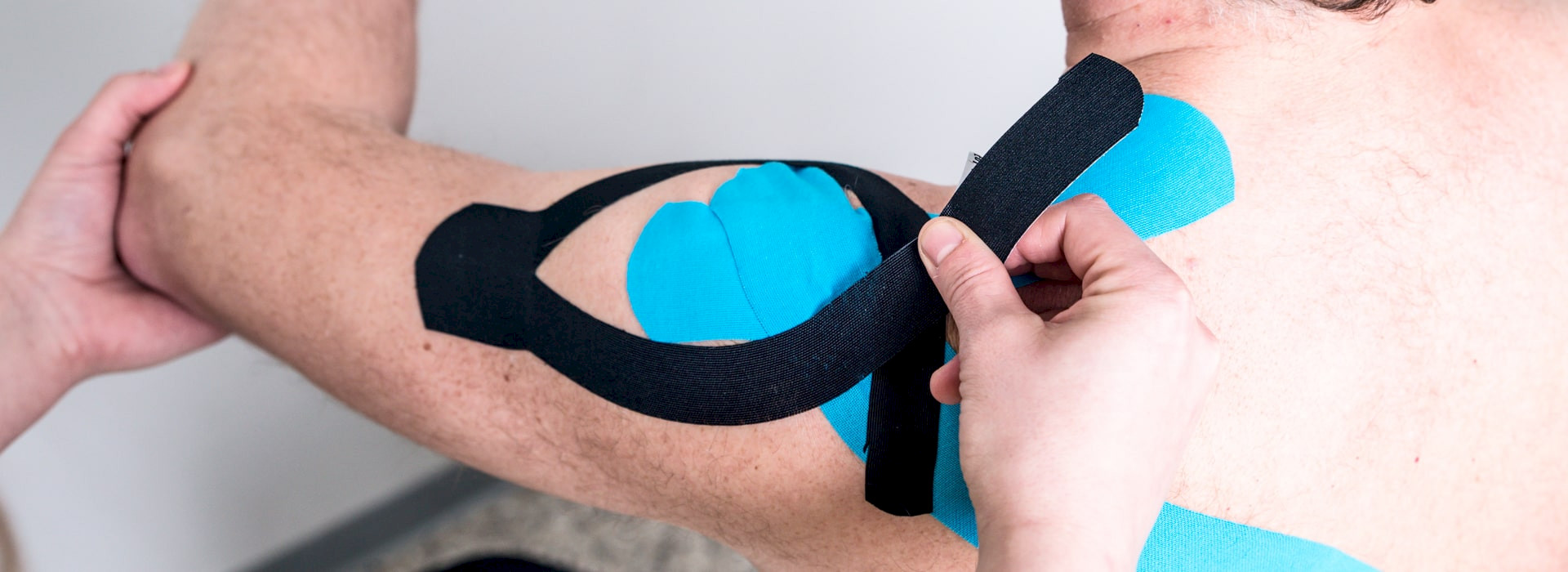
Kinesiology and sports taping
Taping is used to promote rehabilitation, for example in postural training, to restrict movement, support a joint, and reduce swelling. The choice of tape depends on the intended therapeutic outcome of the taping.
The aim of kinesiology taping is to influence pain management through movement of the skin and underlying tissues. In addition, taping can affect joint range of motion, joint and muscle function, posture, and support the body’s circulatory and lymphatic systems.
Our OMT physiotherapists use kinesiology taping as part of rehabilitation, for example to relax muscles, support posture and guide the body into proper alignment, as well as to support recovery after surgery or injury.
The purpose of rigid taping (e.g. sports tape) is to support a joint or to restrict mobility and elasticity in a desired direction. Rigid taping is used, for example, after an ankle sprain to facilitate a faster return to sport, to calm irritation of the plantar fascia, or to support the shoulder area.
Dynamic Tape is a tape similar to kinesiology tape. It is an elastic tape that stretches in all directions. When necessary, it can be applied in layers to increase the level of support. This type of taping is used, for example, to assist the function of a weak muscle or to reduce the load on an overstrained muscle by helping the muscle during activities involving load.